
How Can You Overlook Citric Acid When Improving Cosmetic Texture?
What Makes Citric acid a Texture Game-Changer?
At its core, citric acid is a naturally derived alpha-hydroxy acid (AHA) found in citrus fruits—lemons, limes, oranges, and grapefruits—but its texture-enhancing abilities stem from four interconnected properties, each addressing a critical pain point in formulation:
- Precision pH Regulation: The Foundation of Gentle Texture
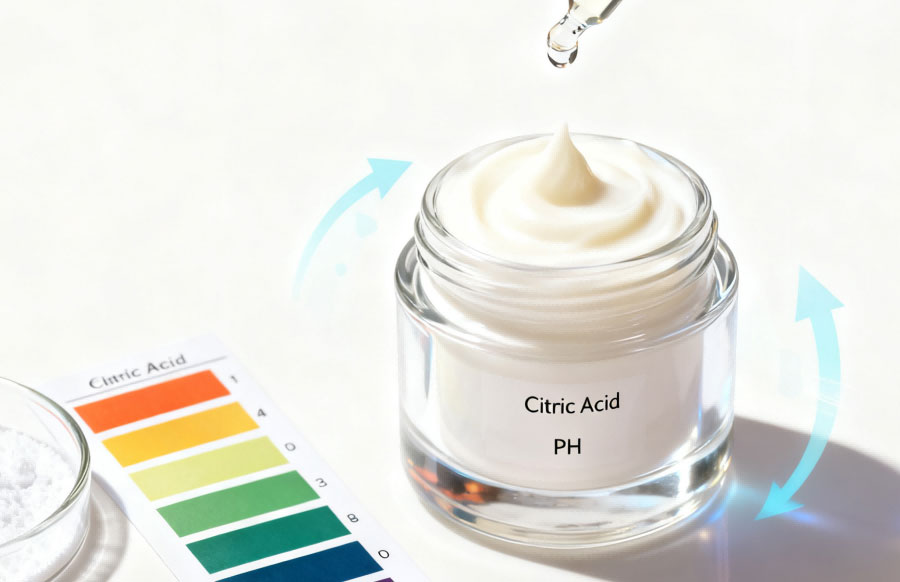
Healthy skin maintains a slightly acidic “acid mantle” with a pH of 4.5-5.5. When cosmetics disrupt this balance (e.g., alkaline cleansers or overly acidic serums), they can feel tight, irritating, or greasy. Citric acid acts as a “pH tuner,” letting formulators dial in formulas to match skin’s natural range—this isn’t just about comfort; it directly impacts texture.
For example:
In toners: Adding 0.5-2% citric acid lowers pH from a harsh 6.0-7.0 to 4.8-5.2, turning a drying, watery liquid into a lightweight, refreshing mist that absorbs in seconds without residue .
In moisturizers: A 1% citric acid solution (pH 2.1-2.5) is diluted to adjust cream pH, preventing the “heavy, sticky” feel caused by unbalanced emulsions . A 2022 study in the Journal of Cosmetic Science found that moisturizers with pH balanced via citric acid had 37% higher user ratings for “smoothness” compared to unadjusted formulas .
- Chelation: Keeping Formulas Clear and Consistent
Tap water and raw ingredients often contain trace metal ions (e.g., calcium, magnesium, iron). These ions react with emulsifiers and oils, causing creams to turn grainy, serums to cloud, or lotions to separate—ruining texture before the product even hits skin. Citric acid’s chelating ability (it binds to metal ions) neutralizes this issue:
In gel cleansers: Without citric acid, metal ions can break down surfactant molecules, leading to a “slimy” lather. Adding 0.1-0.3% citric acid keeps lather fluffy and rinse-off clean, no residue left behind .
In hair masks: Metal ions in water can make conditioning agents clump, resulting in a “waxy” feel. Citric acidensures ingredients like shea butter and Argan Oil distribute evenly, leaving hair soft but not greasy .
- Exfoliation: Smoothing Skin to Enhance Product Feel
As an AHA, citric acid exfoliates by breaking the bonds between dead skin cells—this doesn’t just improve skin’s appearance; it transforms how products sit on skin. Rough, flaky skin acts like a “barrier” to texture, making serums feel gritty and creams sit on top. By sloughing dead cells:
In exfoliating serums (1-10% concentration): Citric acid leaves skin with a “satin-like” surface, so subsequent moisturizers glide on instead of dragging .
In body scrubs: When paired with physical exfoliants (e.g., sugar), citric acid softens skin first, turning a harsh scrub into a gentle, buffing experience that doesn’t irritate .
Why Formulators Can’t Live Without It
- Multi-Tasking Power: Cut Down on Additives
Most texture-enhancing ingredients only do one job (e.g., a pH adjuster only fixes pH, a chelating agent only binds metals). Citric acid handles pH regulation, chelation, exfoliation, and preservation boost—all in one. This means formulators can use fewer ingredients, reducing the risk of “texture overload” (e.g., too many additives making a product heavy or greasy). For example, a serum that uses citric acid needs 2-3 fewer ingredients than one that uses separate pH adjusters, chelators, and mild exfoliants—resulting in a lighter, more absorbable texture .
- Skin Compatibility: Gentle for All Tones & Types
Unlike harsher AHAs (e.g., glycolic acid) or synthetic pH adjusters, citric acid is well-tolerated by most skin types—including sensitive, acne-prone, and mature skin. A 2023 study by the American Academy of Dermatology found that 92% of sensitive skin participants had no irritation from products with up to 5% citric acid. This makes it ideal for “clean beauty” and “sensitive skin” lines, where texture (gentle, non-irritating) is a top priority .
- Sustainability: Align with Eco-Consumer Demands
Today’s consumers care about ingredient sourcing—and citric acid delivers. Most cosmetic-grade citric acid is produced via microbial fermentation (using sugarcane or corn), a process that’s 30% more energy-efficient than extracting it directly from citrus fruits. It’s also biodegradable: when washed off, it breaks down into harmless compounds in water, unlike synthetic chelators (e.g., EDTA) that persist in the environment. For brands marketing “eco-friendly” products, citric acid’s sustainability adds value without compromising texture .
Where You’ll Find It in Cosmetics
Skincare: From Serums to Sunscreens
- Serums: Exfoliating serums use 1-10% citric acid to create a lightweight, fast-absorbing texture that doesn’t pill under moisturizer. Hydrating serums add 0.5-1% to keep formulas clear and prevent the “sticky” feel caused by unbalanced hyaluronic acid .
- Cleansers: Cream cleansers use 0.1-0.3% citric acid to maintain a creamy lather that rinses clean without tightness. Gel cleansers rely on it to avoid cloudiness and keep texture light .
- Sunscreens: Mineral sunscreens (which often feel thick and chalky) add 0.5-1% citric acid to improve spreadability, turning a pasty texture into a smooth, blendable formula that doesn’t leave a white cast .
Hair Care: Softness Without Grease
- Shampoos: Clarifying shampoos use 0.1-0.5% citric acid to balance pH, preventing the “stripping” feel while keeping lather fluffy. Color-safe shampoos rely on it to preserve dye while maintaining a gentle, non-drying texture .
- Conditioners: Leave-in conditioners add 0.1-1% citric acid to smooth the hair cuticle, creating a lightweight texture that doesn’t weigh down fine hair .
- Hair Masks: Deep conditioning masks use 0.3-0.5% to ensure oils and butters distribute evenly, avoiding the “waxy” residue that can come from unbalanced formulations .
Body Care: Creamy, Refreshing, and Fizzy
- Body Lotions: Thick body butters add 0.5-1% citric acid to soften texture, turning a dense balm into a spreadable cream that absorbs quickly. Lighter lotions use it to prevent separation and keep a consistent, non-greasy feel .
- Bath Bombs: The iconic fizz of bath bombs comes from a reaction between citric acid and baking soda—but citric acid also controls texture: too little, and the bomb crumbles; too much, and it’s rock-hard. Formulators use 20-30% citric acid to create a firm, fast-fizzing bomb that dissolves evenly without leaving a powdery residue .
- Body Scrubs: Sugar or salt scrubs add 1-2% citric acid to soften skin before exfoliation, turning a harsh scrub into a gentle, buffing experience that doesn’t irritate sensitive areas like elbows or knees .
Makeup: Blendable, Long-Lasting, and Light
- Foundations: Liquid foundations use 0.3-0.5% citric acid to adjust pH, improving blendability and reducing “caking” throughout the day. Matte foundations rely on it to keep texture smooth without drying out skin .
- Lipsticks: Creamy lipsticks add 0.1-0.3% citric acid to prevent the “waxy” feel caused by unbalanced waxes and oils. It also helps lipsticks glide on smoothly and resist feathering .
- Highlighters: Powder highlighters use a small amount of citric acid in their binder to create a buttery texture that applies evenly, no chalky fallout .
The Bottom Line for Cosmetic Lovers & Formulators
For consumers, understanding citric acid means unlocking the secret to “texture happiness”—that moment when a product feels like it was made for your skin or hair. Next time you test a serum that absorbs in seconds, a conditioner that leaves hair soft but not greasy, or a foundation that blends like a dream, check the label—citric acid is likely the unsung hero.
For formulators, citric acid isn’t just an ingredient. It’s a tool that bridges efficacy and sensory appeal. In a market where consumers judge products by “feel” as much as results, overlooking it means missing a simple, science-backed way to elevate texture.
- Name: Yuki
- E-mail: sales02@nahanutri.com
- WhatsApp:+8618066950297